

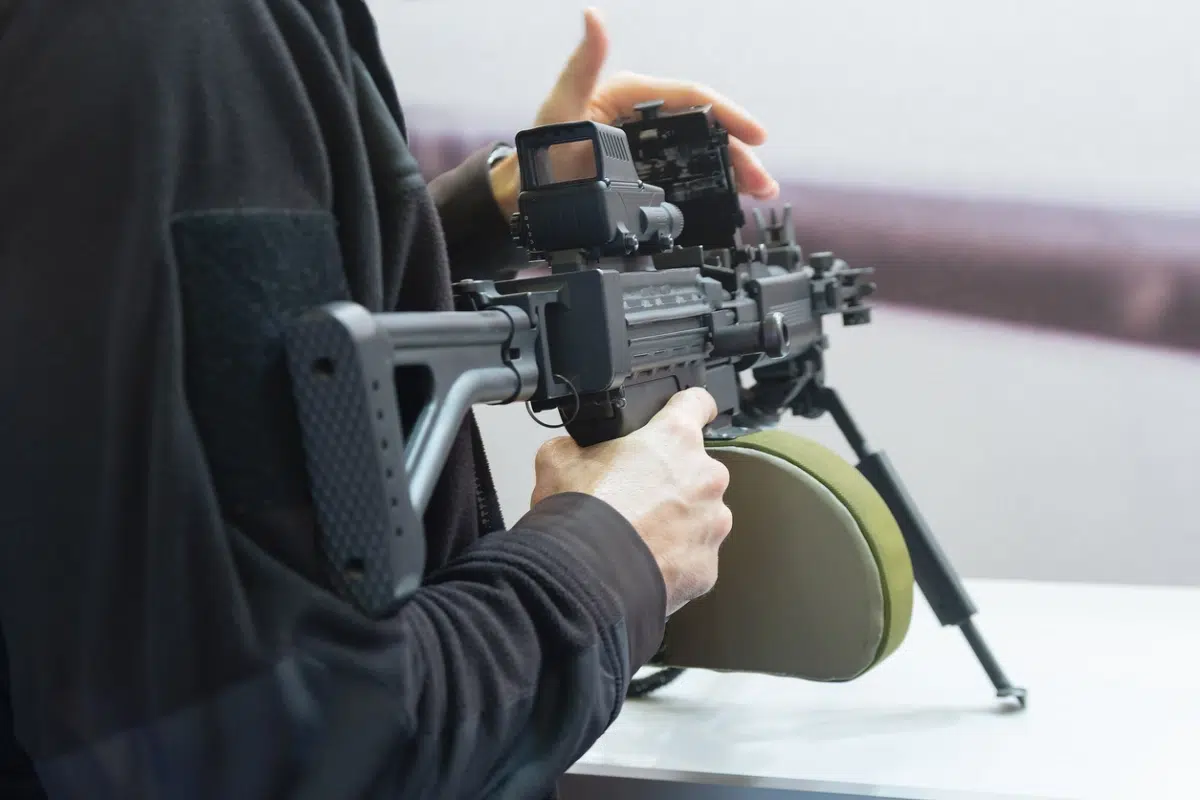

Machine gun ownership is one of the most heavily regulated areas of firearm law in America. Federal law, Supreme Court rulings, state law, and local rules all come into play. Additionally, there is a great deal of rhetoric about fully automatic firearms and who should be able to own them.
If you are facing allegations of violating gun control laws for machine guns, working with an experienced team handling criminal defense matters involving weapons offenses can help you enforce your legal rights.
A machine gun possession attorney will evaluate the legitimacy of the charges against you and help you determine the best option for defending yourself.
Learn the answers to questions like “What federal laws regulate machine guns in the U.S.?” and “Are machine guns legal in the U.S.?” so that you can better understand your rights when it comes to the lawful possession of fully automatic weapons.
The Historical and Regulatory Framework of Automatic Firearms
Modern machine gun laws in the United States date back to the early 20th century. These federal laws were created in response to organized crime violence that involved machine guns.
The federal government responded by passing the National Firearms Act of 1934 (NFA), which imposed taxes and registration requirements on legal machine guns.
The NFA also implemented a transfer tax, which made civilian ownership more difficult due to the financial burden.
Discussions about automatic weapon laws in the USA center around the NFA, as well as later laws such as the Gun Control Act of 1968. There were also later federal laws passed that restricted civilian ownership even further.
Under the National Firearms Act, machine guns are weapons that can fire more than one round with a single trigger pull. That definition extends to certain conversion devices and firearm parts that allow a semi-automatic weapon to function in full auto.
Machine gun ownership laws are regulated under the NFA framework. Most NFA firearms require you to complete a background check and obtain federal approval before you can take possession of the weapon.
Private citizens enjoyed a win at the beginning of 2026, as the long-standing $200 tax stamp for NFA firearms was reduced to $0. Previously, you had to pay the $200 tax stamp fee for all NFA firearms individually.
While United States machine gun laws have remained largely unchanged for a few decades, state law in several jurisdictions continues to get stricter. These changes are made in response to gun violence and the common use of so-called “assault weapons.”
The 1986 Hughes Amendment and the Transferable Registry
One of the most important developments in machine gun laws in the United States occurred in 1986 with the passage of the Firearm Owners Protection Act.
However, the Hughes Amendment was a last-minute addition to this legislation and banned civilians from possessing or transferring machine guns that were manufactured after May 19, 1986. The ban applies to any newly manufactured full-auto firearms that were produced after the 1986 deadline.
Thanks to this federal law, civilians may generally only possess machine guns that were lawfully manufactured and registered before the cut-off date.
These firearms are commonly referred to as transferable machine guns because you can own them privately. However, state machine gun ownership laws can make that complicated, even if you are lawfully eligible at the federal level.
The Hughes Amendment is considered one of the toughest and most impactful federal firearm regulations for automatic weapons. It drastically reduced the number of legally transferable automatic firearms in circulation. Since there is a fixed supply of machine guns, the law also drove up the price of automatic weapons.
Technically, machine guns are legal in the United States under the National Firearms Act. However, automatic weapons are incredibly costly. Machine guns can range from a few thousand dollars to tens or even hundreds of thousands of dollars.
In that regard, the federal law known as the Hughes Amendment had its intended impact on lawful gun owners in the U.S.
Mechanical Distinctions: Fully Automatic vs. Semi-Automatic Platforms
Federal law treats fully automatic weapons as machine guns. The definition is broad. It refers to weapons that can fire more than one round with a single trigger pull. Semi-automatic rifles that have been modified to function like machine guns can also fall under the NFA, which makes the matter even more complicated.
A semi-automatic firearm fires exactly one round for each trigger pull. Even seemingly simple conversion devices that alter this functionality can lead to a weapon being classified as a machine gun. Many jurisdictions have implemented state laws to ban these devices, which may include:
- Bump stocks
- Binary triggers
- Conversion switches
- Drop-in auto sears
Simply possessing a firearm equipped with one of these devices, or the device itself, could result in criminal charges under federal or state law. If you encounter a law enforcement official while in possession of one of these devices, the device could be confiscated, and you could be placed under arrest.
If you are unsure of the legality of a firearm or a conversion device, it’s best not to own it. If you haven’t purchased the device or firearm in question, consider consulting with a firearms attorney in your state. An experienced firearms lawyer can help you determine whether there is a law prohibiting you from possessing the device or weapon in question.
Navigating the NFA Tax Stamp and Form 4 Approval Process
One of the most misunderstood aspects of firearm regulation involves the NFA transfer process. If you want to lawfully own machine guns or other NFA firearms, you’ll need to:
- Complete ATF Form 4
- Submit fingerprints and photographs
- Pass a federal background check
- Receive formal approval from the ATF before taking possession
If you are purchasing the weapon from a federal firearms license holder, they will make sure you complete all of these steps so that they do not commit a crime by turning the weapon over to you. However, you are required to complete these same steps when transferring NFA firearms from a private gun owner.
Before initiating the process, check state laws in your place of residence. Many states have passed bans on full-auto and “assault weapons.” These rules tend to be even more restrictive than ATF regulations. The weapon must be lawfully possessed under both federal and state law to avoid criminal penalties.
The Role of Special Occupational Taxpayers (SOT) and FFLs
A special occupational taxpayer is a specific type of FFL who pays the ATF an annual tax for the right to manufacture, import, or deal in NFA items. Federal firearms licensees who maintain an SOT status may handle and possess machine guns that ordinary civilians cannot.
An SOT can facilitate the sale and repair of NFA-regulated firearms. If you are interested in purchasing an NFA item, such as an automatic weapon, short-barreled rifle, short-barreled shotgun, or suppressor, dealing with an FFL dealer who possesses an SOT is usually the simplest option.
An FFL will walk you through the process of filling out your ATF Form 4 and submitting the required fingerprints and photographs. The approval process can take anywhere from a few weeks to several months, depending on how many applications the ATF is currently processing.
State-Level Prohibitions and Multi-Jurisdictional Conflicts
Even if federal law permits you to own machine guns, state law may still prohibit it. Some states allow civilian ownership if they meet federal registration requirements. Other states have broad or blanket bans on machine guns.
A handful of states have taken these bans even further, outlawing a wide range of “assault weapons,” which may include semi-automatic firearms with higher capacity magazines.
Assault Weapon Bans and Additional Restrictions
Before making a purchase or initiating the ATF Form 4 application process, check your state law for bans on:
- Assault weapons
- Machine guns
- High-capacity magazines
- Other NFA items
For example, Indiana allows machine guns and other NFA items. However, you have to obtain a certification from a state law enforcement officer to obtain a federally regulated firearm. This step is necessary in addition to the federal requirements.
Federal Criminal Penalties for Illegal Possession
The federal penalty for possession of a machine gun is up to 10 years in prison and up to a $250,000 fine. If you are facing state or federal firearms charges, especially those involving machine guns, seeking legal representation is a necessity.
It’s always helpful to have federal machine gun laws explained by someone with knowledge of the laws. However, the legality of machine guns in the U.S. largely hinges on state laws.
The criminal defense attorneys at Gemma & Karimi Law assist with a wide variety of firearms-related cases in the state of Indiana. Our Indianapolis-based legal team stands up for the rights of gun owners and citizens who are facing criminal charges.
If you would like to schedule a consultation regarding machine gun laws in the United States or other gun-related questions, contact us today. Our team can also provide an Indiana firearm laws overview to address specific legal gun ownership questions you may have.